Introduction
What is it about creative geniuses – artists, architects,
music composers – that they manage to leave important projects unfinished?
And as an afterthought, could such a fate ever befall written communicators?
Start with music.
Many of the world’s most celebrated composers failed to complete some of
their works. Include Bach, Mozart,
Beethoven, Mahler, Schubert, and Tchaikovsky.
Examples include Mozart’s Requiem, which was completed
after his death by his contemporary and student Sussmayr; Mozart’s incomplete
works include six operas and his Mass in C minor; Mahler’s 10th Symphony
was completed by the musicologist Deryck Cooke in the 1970's; Elgar’s Third Symphony was completed from the
composer’s sketches by Anthony Payne in more recent years; and Bruckner completed
three movements for his 9th Symphony, leaving others to use his
sketches of the final movement to finish the work.
All of which beg philosophical questions, such as:- in what
circumstances do composers fail to finish musical works; is it right for others
to make completed versions; and what issues arise in such proxy undertakings?
Music’s function
Responding to all three questions in the round, a
reminder of the purpose of music might help.
Music makes life memorable and melodious. Like a page-turning book, its story-telling
embraces all facets of human activity - love and death, war and peace, joy and
sadness. Music soothes, inspires and
provokes thought.
When musical composition is unfinished, its full creative
impact and beauty is diminished or lost. There is no climax. The listener is deprived of the final
outcome. There is no greater
disappointment than a wonderful story left dangling without a conclusion.
Therein lies a prima facie rationale for
another composer’s desire to complete in the event of the original’s
indisposition.
Music’s key tools include the use of melody, harmony and
dissonance, with an occasional (sometimes indefinite) pause. On which subject, the operative phrase - unfinished works question-mark – implies
a command.
Define unfinished
In a sense, no musical work is ever completed insofar as
there may always be room for improvement.
This can be either in the nuanced details of composition or in the
subtleties of interpretation in performance.
As an integral part of everyday life, music does not
exist in isolation. Hence, the process
of composing music faces the same challenges as everyday activity – time,
ingenuity, resources, and drive. The
reasons for a musical work lacking a finale or important sections are
understandable in this context.
The best-known example of all of music is Schubert’s Symphony number 8 in
B minor (Unfinished). Not only did he
fail to finish six symphonies, but Schubert is the only composer to have one actually entitled
Unfinished[i].
Frustratingly, the programme notes[ii] from a recent performance
in Belfast offer little to define the circumstances for the composer’s
incompletion of “this obvious masterpiece.” A vague comment speculated that
“he
dropped it, never to resume work....maybe he simply didn’t know where to go
next.”
The death in March of the classically-trained Sir George
Martin reminds us that many unfinished Lennon-McCartney songs depended on his
orchestration and scoring to bring them to completion[iii]. The 1967 Sunday Times review of Sergeant
Pepper’s Lonely Hearts Club Band album spared no praise in declaring loudly that
“She’s
Leaving Home” is just as sweet as any Schubert song.”
Reasons for not finishing
More convincing explanations for incomplete works stem
from the self-evident. These include
death or infirmity of the composer, interruption by another commission,
dissatisfaction with the work, and loss of inspiration.
I would venture to add other prospective causes.
To understand why accomplished composers have left works
unfinished necessitates an insight into the genius’s personality. Compositional mindset seems bound to be
influenced by physical and mental health, as well as by personal and domestic circumstances.
No single personality profile fits all composers. One characteristic they share is exceptional
creative instinct. The outcome is
prolific output. Haydn exemplifies this
trait prodigiously. He was meticulous
enough to catalogue his work with openings included. These have helped musicologists
to identify lost works. Despite his
organisational assets, however, Haydn's wife is reported to have shown disdain for
his music by using his manuscripts for pastry-pan linings[iv].
That source adds that only one of Haydn’s 108 symphonies
has been lost. This prolificacy gives a
lie to Schoenberg’s hauntingly-superstitious comment about the deathly failure
of Mahler and Bruckner to finish key works
“he
who wants to go beyond a Ninth must pass away[v].”
Creativity is likely to exhibit itself in quality as well
as quantity.
For example, in the
consequent desire to capture the constant flow of inspiration, to cope with the
urges to express the next idea (which is already gestating in the creative
consciousness), started works may be postponed.
The composer frantically strives to record new ideas lest they are lost
in a gushing torrent of inspiration.
Multi-tasking will probably exacerbate matters.
Could this restlessness explain the numbers
of unfinished works by composers such as Mozart, Schubert and Beethoven?
As an example of the relentless zeal demanded by
composition, this line from Mussorgsky[vi] when he was writing
the beautiful Pictures at an Exhibition nails it:
“The
piano suite is swirling along: the air is thick with its sounds and its
idea. I’m devouring it all, gorging on
it, and I can barely get it down on paper.”
Mussorgsky had simultaneously been working on his opera
Khovanshchina. Although excessive consumption
of alcohol may have been another influence, he did not finish the opera[vii]. His friend Rimsky-Korsakov completed it after
his death.
In other cases, the trait of perfectionism is likely to
result in procrastination for eventual reworking and enhancement. Perhaps this explains why Tchaikovsky, who was
sensitive to criticism, left three operas and some other works unfinished. It seems reasonable to surmise that the
obsessive quest for peak perfection may result in unfinished work if it is
deemed to fall even a smidin below magnificent.
Similar reasoning is used in an expert analysis of
Schubert’s Unfinished 8th symphony.
The critic Tom Service suggests a combination of[viii] the composer’s
syphilitic pain, his musical capacity to reproduce the quality, and/or getting
on with new projects.
He reflects my
opinion concluding that although
“unfinished
strictly, it is a complete essential and mysterious symphonic experience.”
Another factor is the seemingly mundane matter of administration. In particular, consider the composer's capacity (and that
of his family and friends) for organisation of paperwork.
At Bach's
beath, for example, he had left a manuscript copy of contrapuntal
pieces. The work's fourteenth and final fugue was unfinished,
lacking a title, tempo, markings and instrumentation.
Discussion about
the role and completion of the Art of the Fugue has continued unabated[ix] from the composer's son, through Mozart and up to the modern era.
Andrew Mellor explains [x]
“at bar 239 the music
breaks off suddenly, the score appended with the words – at this point the composer died – a sobering reminder that not even genius
can escape mortality.”
Other explanations
The composer’s financial and other personal circumstances
will affect his drive, job satisfaction and pride in the work. Further influences on the impetus to start
and to complete the composition include the brief (which may or may not have
been restrictive) and the project objectives of the commissioner (such as
working to a tight deadline or for a particular event).
Reasons can also include external matters such as climate
and weather, politics, censorship, and changing fashions. Some Beethoven composition perished in floods.
The current best-seller “The Noise of Time[xi]”
graphically imagines the visceral story of Shostakovich’s struggle to cope with
Communist tyranny. The banning of his
opera Lady Macbeth of Mtsensk and the
infamous Pravda editorial denouncing the composer[xii] resulted in four other
Shostakovich operas being left unfinished or abandoned[xiii].
Morality of proxy completion
There is no single correct or incorrect answer to the
ethics surrounding third-party completion of unfinished works. It depends on the circumstances.
To illustrate the dilemma, look outside the
musical box for context. Music faces the
same challenges as art and architecture.
Their celebrated exponents have likewise had uncompleted projects
concluded by others.
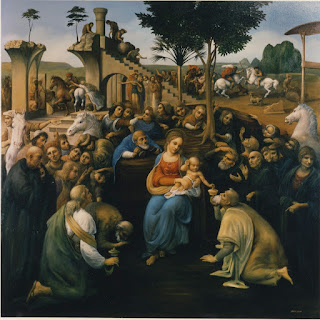
Two of Da Vinci’s[xiv] most famous works, the
Mona Lisa and Adoration of the Magi were unfinished.[xv]
The latter original unfinished masterpiece is
displayed in the Uffizi in Florence; a finished version was done in 1995. Critics, scholars and the public have the
consequent luxury of being able to view both, engage in heated debates about their respective merits while comparing one with the other.
 |
| Adoration of the Magi, DaVinci. Unfinished |
 |
| Adoration of the Magi. Finished version 1995 by David Jean |
Rembrandt, whose final self-portrait was hanging in the
Ulster Museum[xvi]
until mid-March this year, left many other self portraits unfinished.
 |
| Rembrandt's final self portrait |
This was because he is said to have regarded
them as “unsuccessful.”[xvii] If that reflects the artist’s opinion, what
justification is there in attempting to trump him?
In architecture,
consider Gaudi’s Basilica of the Sagrada Familia in Barcelona.
Decades
after the architect was fatally knocked down and after prolonged controversy
about his intentions, this epic work was finally consecrated as a place of worship by
Pope Benedict XIV in 2010. Who would
have the bravado to assert that it is wrong for others to complete such works?
Something similar applies to the many uncompleted
buildings arising from the global financial crisis of 2007/08. Would anybody suggest that such work should
remain uncompleted, especially when economic circumstances improve?
The same rhetorical questions apply to music.
On the one hand, proxy completions aimed at
second-guessing the composer’s mind have arguable worth because they both
intrigue the listener as well as providing audiences with alternative
outcomes completed by experts with special skills and knowledge of the composer.
On the other, who can really judge
whether the outsider’s completion provides a deus ex machina that
satisfactorily untangles the uncompleted narrative and in the appropriate
style?
Communicating to eager audiences through music architecture and art is one thing.
It leaves me wondering about written communication.
What if I were to fail to conclude an article for
©Michael McSorley 2016
References:
[i] Sinfini Music
article by Andrew Mellor 18 June for Courthaulds Summer 2015 Showcase
Exhibition of unfinished art.
[ii] Ulster Orchestra JTI
lunchtime concert 2 March 2016, programme notes Richard Bratby. He adds “every attempt to complete the
symphony including a cash prize in 1928 has failed abysmally.”
[iii] Arena BBC TV 25 April
2011
http://www.bbc.co.uk/iplayer/episode/b010t9hz/arena-produced-by-george-martin
[iv]
http://www.britannica.com/biography/Joseph-Haydn
[v] Sinfini Music
article Andrew Mellor18 June for Courthaulds Summer 2015 Showcase Exhibition
[vi] Mussorsky Pictures
at an Exhibition etc. Mariinsky Orchestra. CD Notes by Leonid Gakkel
[vii]
http://www.britannica.com/biography/Modest-Mussorgsky
[ix]
http://www.fdavidpeat.com/bibliography/essays/dentler.htm
[x] Sinfini Music
article Andrew Mellor18 June for Courthaulds Summer 2015 Showcase Exhibition
[xi] Julian Barnes (Man
Booker Prize-winner 2010) “The Noise of Time” published 28 January 2016
[xiii] The Big Lightning
(1932), Orango (1932), The Twelve Chairs (1938) and The Gamblers (undated)
[xvi]
http://www.culturenorthernireland.org/features/visual-arts/rembrandt-drawing-club-and-me?utm_source=Culture+Northern+Ireland&utm_campaign=7b7ba49bc9-CNI+Newsletter+-+July+23&utm_medium=email&utm_term=0_e5d62de437-7b7ba49bc9-58427593


